Team Led by Prof. LIN Yen-Hung Boosts Solar Cell Efficiency and Durability Through Breakthrough Molecular Interface Design
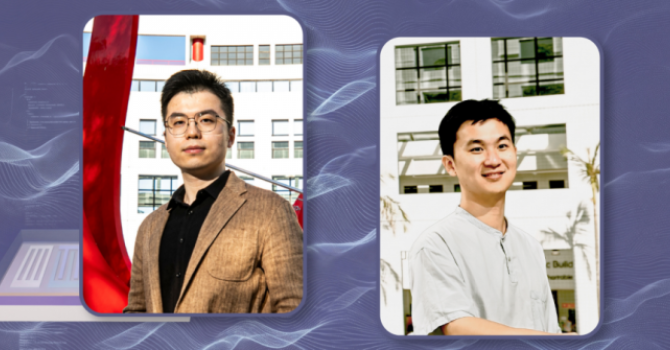
Researchers at HKUST have demonstrated that molecular interface engineering can significantly boost both the efficiency and lifespan of next-generation perovskite tandem solar cells. Led by Prof. LIN Yen-Hung and Dr. Fion YEUNG Sze-Yan, two collaborative studies published in Joule and Nature Communications show that custom-designed molecular layers reduce energy-wasting defects, control crystallization, and protect solar cells against environmental degradation.
In the Joule study, titled “Interface-mediated crystallization enables PEDOT:PSS-free all-perovskite tandems with 29.1% efficiency and enhanced durability”, the team tackled two-terminal monolithic all-perovskite tandems by replacing a moisture-sensitive polymer (PEDOT:PSS) with a specialized self-assembled monolayer. This switch eliminated interface instability and guided proper film crystallization, allowing the team to achieve a record-high 29.1% power conversion efficiency for PEDOT:PSS-free all-perovskite tandems while retaining 90% of initial efficiency after 800 hours of continuous testing.
The Nature Communications, titled “Self-assembled 1D/3D heterojunction enables all-inorganic perovskite 4-terminal tandem solar cells with 21.54% certified efficiency” study focused on four-terminal all-inorganic perovskites, using a self-assembled molecule (TTFS) to create a protective 1D/3D surface heterojunction. This strategy formed a moisture-blocking barrier while passivating surface defects, driving the device to a record 21.54% certified efficiency and maintaining strong thermal stability under prolonged heat. Together, both approaches highlight molecular interface design as a vital key to commercially viable perovskite photovoltaics.
Related link: